The art
Onnagata on the popular stage
Why young men dance the female roles in taishū engeki, where the onnagata tradition began in kabuki, and what to watch for in the make-up and movement.
Find a performance day ↗Quick answer
Onnagata are male actors who play women. The role took shape in kabuki after women were banned from its stages in 1629, and taishū engeki troupes keep it alive: although these troupes include actresses, young men frequently dance the female parts, while women rarely play men. Expect white make-up, red lips, elaborate wigs and slow, controlled movement.
Where the role began
Kabuki began in the early seventeenth century, and many early troupes were all female, with women playing men where needed. In 1629 women were banned from performing kabuki, and all-male casts became the norm. Actors who specialised in women's roles were called onnagata, literally female role, or oyama. Later bans tried to control the role too, but it survived and became one of kabuki's defining arts, with its own training, make-up and manners.
What the training asks
Wikipedia describes the techniques an onnagata must master over years: moving gracefully across the stage in geta sandals, a softer posture with lowered shoulders and bent knees, and a falsetto voice used throughout a performance. The falsetto is not meant to copy a woman's voice exactly; it suggests femininity through intonation. In a dance revue the voice matters less, and the body does the work: sleeves, hands, the tilt of the head.
After the Meiji era
During the Meiji era the ban on women performing was lifted, and women began to appear in kabuki in onnagata roles, though this stayed uncommon: the standard remained a male actor trained in an artistically feminine style. When film reached Japan at the end of the nineteenth century, oyama also played women on screen until the early 1920s, when actresses came into fashion with realist films, and in 1922 the oyama staged a protest at the Nikkatsu studio over the loss of work. In contemporary kabuki, onnagata is its own theatrical role with its own training.
Onnagata in taishū engeki
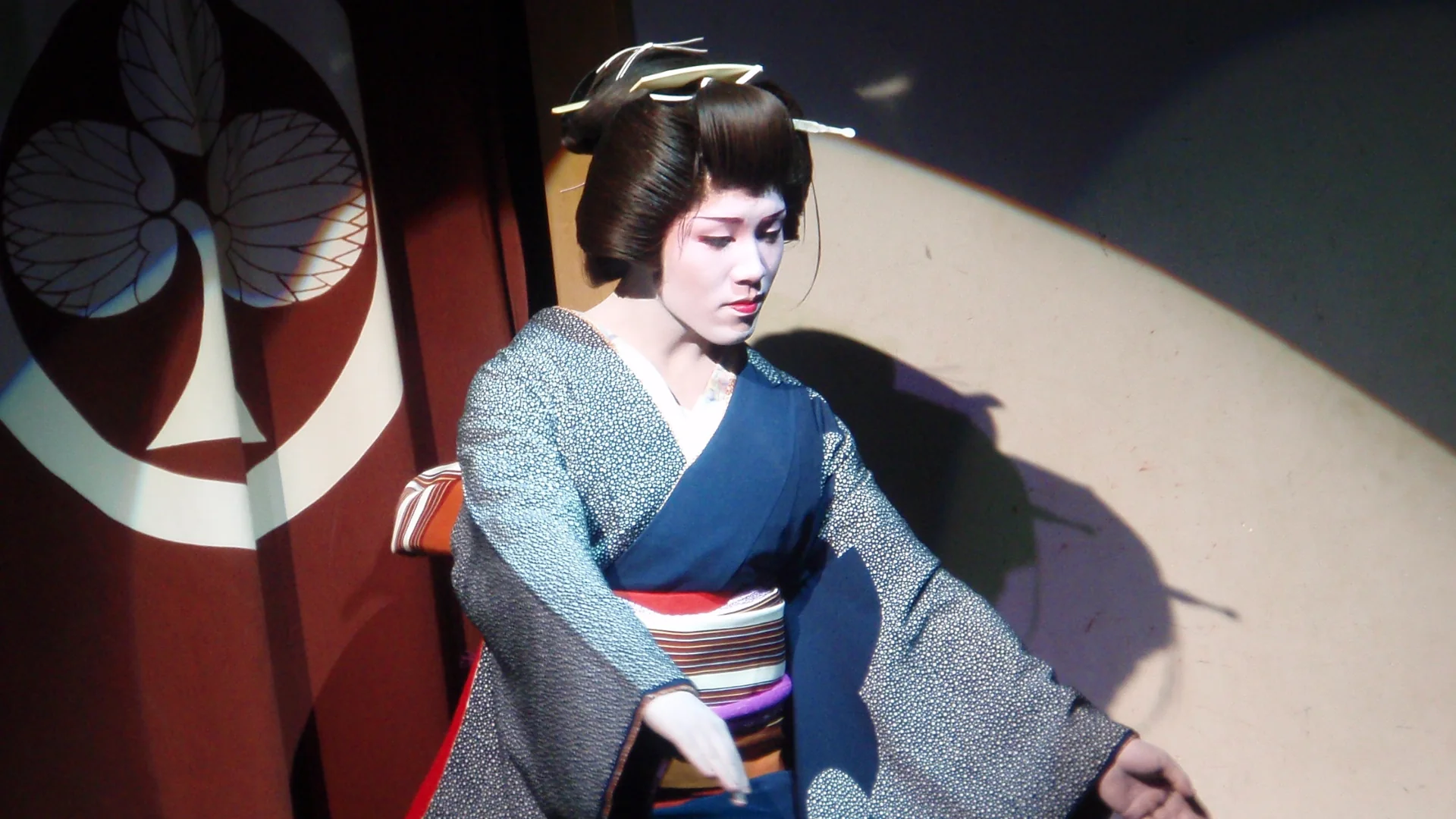
Unlike kabuki, taishū engeki features performers of both sexes. Even so, young men frequently play female parts, while women rarely play men. In the dance half of a performance each actor dances alone, and an onnagata number in a bright kimono, under a spotlight and a drift of stage fog, shows the form at its most theatrical. Wikipedia notes that the form shares a good deal with the all-female Takarazuka Revue and with the all-male tradition of kabuki.
The make-up and the look
Costume and make-up in taishū engeki are closely related to kabuki's: a porcelain-white face, bright red lips and strongly emphasised eyes and eyebrows, aiming at an unreal, stylised beauty rather than realism. The costumes are made to catch the eye. In a small theatre you sit close enough to see the detail, which is part of the appeal of the form.
What to watch for
Watching a dance with these in mind turns a pretty number into a display of skill, and makes it easier to see why particular performers draw the loudest shouts.
- How the sleeves move with each turn
- The walk: knees bent, shoulders lowered, steps kept small
- The face: held still under the white make-up
- The tip: when fans walk up, the dancer kneels at the stage edge to receive them
Watching without the words
For a visitor with no Japanese, an onnagata dance is the easiest part of a taishū engeki performance to enjoy. There is no dialogue to follow, only music, movement and costume, and the dancer is alone on the stage. Let the song wash over you, watch the hands and sleeves, and notice how the audience responds: the regulars know these performers well, and their tips, letters and bouquets tell you who the troupe's favourites are. If you book the guided option, ask staff during the briefing what to look for.
A tradition that travels
The influence of onnagata reaches well beyond the theatre. Wikipedia traces it into Japanese rock's visual kei scene and into international drag performance, and a 2025 Japanese film about two rival onnagata became the highest-grossing Japanese live-action film. In Asakusa you see the tradition in its most popular form, performed by touring families for a local audience, close enough to hear the silk rustle.
Sources